On..."I Knew It, I Knew You," Part II
Welcome to Part II of my thoughts on "I Knew It, I Knew You," Taylor Swift‘s original song for Toy Story 5!

If you know me, you know that Taylor Swift and Disney/Pixar are two of my favorite things in the world.
(All I need now is a Starbucks collab drink based on the song in the movie and I’d have the trifecta...)
Ever since this collaboration was announced, I’ve been having All The Thoughts. And: practice what you preach. One of the main, foundational ideas of my course is that "writing is thinking and thinking is messy." So, rather than write one, long, unwieldy post, I took a break, walked away, walked-and-talked through my thoughts, and started a new post.
Part I was a little bit longer than I expected but I tried to cover Pixar‘s relationship with music in its films; music in the Toy Story films, specifically the Oscar nominated songs; and some of my initial impressions and observations about the lyrics of this one.
Now comes the synthesis part: taking all the pieces, putting them together, and trying to make some sort of sense of them. As I said in my last post, this is all just "academic fun," pure speculation, a thought exercise. But I do think we can theorize about (1) where this song might fit in the film and (2) how this song might reflect or connect to the overall plot.
I. My Best Guesses
I wanted to start by briefly listing my "most likely scenarios" so far, and then I'll get into why. This is by no means an exhaustive list; just my best guesses based on the song lyrics and what we know about the plot of the film from interviews, trailers, and promotional clips. IMO, the song could be:
at the "emotional heart" of the film -- much like in Toy Story 2, about midway through the film -- as Jessie returns to Emily's house and remembers their relationship
at the "emotional heart" of the film, if Jessie and Older Emily reunite
at some point in the film, as Jessie finds a new purpose with a new kid (maybe Blaze?)
at the structural climax of the film -- near the end, but not the end credits -- where Jessie & the Toys return to Bonnie
At this point, my best / favorite guess -- partly because of what it could mean for the message of the film -- is the last one. Let's get into why.
II. The First Trailer
JK. Before that, I want to include the first full-length trailer for the movie, from a few months ago, as I think it's actually quite revealing about the overall arc of the film (and maybe where Taylor's song fits in):
From the trailer, the basic plot structure seems to be:
Bonnie still has an "analog" childhood, playing with toys + imagination, but might be alone in that
➡️ She might be having trouble making friends in general, or with the new kids in the neighborhood, who all have "iPads"
➡️ Bonnie's parents, probably to help Bonnie, get her an iPad
➡️ Bonnie becomes engrossed with it, forgetting about her toys
➡️ The central tension between Toys and Tech is established -- as Woody says, "Toys are for play, but tech is...for everything."
➡️ Jessie reaches out to Woody, who returns home and...makes things worse?
➡️ We see Lilypad say "so long toys!" after what looks like lines of code appear on her screen, then we cut to Jessie + Bullseye in a car, with Bonnie and a suitcase (backpack?) in the background -- this might be a sleepover, as we see Bonnie in the same shirt from outside the window of a house, at night
➡️ This is where the trailer starts picking up, putting together brief shots of scenes, quickly moving from one to the next, but the basic gist is that Jessie ends up (somehow) at Emily's old house, realizes "Bonnie still needs us," and then has to make it back home to Bonnie.
➡️ Also, at some point, the toys end up in a (donation?) box in the garage, and Buzz and Woody escape (I think to follow Jessie and/or let her know that Bonnie isn't as happy as maybe Jessie thought she was).
Worth noting: I think the scene at the beginning of the trailer may actually occur at the end of the film, rather than the beginning, as it's supposed to look like. When we see Bonnie playing with the toys outside, she's wearing an outfit with turquoise puff sleeves and a purple long-sleeved shirt underneath. When we see her opening the iPad, she's wearing a yellow long-sleeved shirt with a mint shirt on top, and a pink skirt.
The trailer is cut to look like Bonnie abandons her outdoor, imaginative play to open the iPad, but unless she pauses for a costume change, that might not be the case. (This would also mean that Forky and Karen's wedding occurs later in the film, so I'm not entirely sure about this theory.)
III. What Else Do We Know?
As we get closer to the release date of the movie, we're starting to get more information about the film, mainly from interviews with people involved in it, some of which I think are really telling.
Tom Hanks says there's "heartbreaking scene" in this film, related to tech, per The Hollywood Reporter. Lily Ford reports that, speaking at the UK launch event, Tom Hanks said, "There’s one of the most heartbreaking scenes I’ve ever seen in any of the Toy Story movies — when that little girl is getting her feelings hurt by what other people are texting about her, and she doesn’t understand why. She doesn’t know what she did wrong, but it hurts, and that is a very prescient thing to have in a motion picture today about little kids and toys, don’t you think?” This, I think, is crucial: this might be the catalyst for Jessie to return home. She might leave (or be forced to leave), thinking Bonnie is happier with her technology; but after this incident, maybe Bonnie turns to Jessie for comfort, and is unable to find her, prompting Woody & Buzz to bring her back.
Tech -- i.e., Lilypad -- is not the villain. Andrew Stanton told Variety: "She is [the villain] to the toys because they’re understandably intimidated...She’s just the next phase in Bonnie’s life. She’s built like a toy in the sense that she wants to help the kid go forward, but she’s got very different skills and zero experience..." On a similar note, McKenna Harris (the co-director) revealed: "Lots of people at the studio wanted her to be a villain, and it was so hard to strike the balance because I think we all come in with such loaded emotions towards devices. At the end of the day, it never made sense. We’re not getting rid of these devices, no matter how hard we try. I’m always going to have my phone. I’m probably going to be partially addicted to it. So it felt right for the toys to have to grapple with that nuance." If tech isn't the villain -- the antagonist, yes; villain, no -- and the toys "have to grapple with that nuance," I can see the "villain" (in true Pixar fashion) being the kids' relationship with technology, and its effect on their social skills and relationships (something like cyber-bullying, but maybe not as heavy).
We know that Jessie returns to where Emily lived, but Emily isn't there. In this same Variety article, we learn that: "In the film, Jessie finds herself returning to her former home. Except, Emily doesn’t live there anymore.[...] Jessie’s storyline promises to be an emotional one as she is forced to reckon with some memories of the house, Emily and issues of abandonment." This seems like it might be the "emotional heart" of the film, where Jessie has to address her past and those "issues of abandonment" -- because if Variety only saw the first 30-45 minutes, we must get to this part fairly quickly. Either way, it seems Jessie is going to have to grapple with some stuff, much like Woody did when he first arrived at Bonnie's house in Toy Story 3.
Living in Jessie's house is a new family, and the character of Blaze seems central to Jessie's story.

This is from Disney Wiki, and has 2 interesting pieces of information.
The first is that they identify Blaze as a "millennial" which -- what!? I have questions. Is Blaze actually a Millennial? Because the youngest of us were born in ~1996 so would be about 30.
If she's not a Millennial, can we please stop identifying all younger generations as Millennials? Please? (I know this is on the Wiki, not Disney/Pixar, but still.)
If she is one, I'm not sure how I feel about the larger commentary here on Millennials and toys.
As Entertainment Weekly reports, we learn:
...Blaze "and her family live on a ranch in the same home where Jessie and her first owner Emily used to live";
...that Blaze is, according to her voice actress Mykal-Michelle Harris, "a spunky, funky, equestrian horse girl" [Sidebar: LOVE that description]
...that Blaze "was raised on a ranch with her family, and she's never afraid to be herself. She's an older kid, but she's not afraid to play with toys or to have a whole bunch of horse figurines. That's kind of her thing.”
So, yes, it seems unlikely that Blaze is a Millennial as Harris calls Blaze an "older kid."
Even though Disney Wiki also calls Blaze "a young girl whom Lilypad sent Jessie to."
Interesting.
There is the moment in the trailer where see boxes of code pop up, and then there's the glimpse of "eBid" (a version of Ebay?) from the final trailer, so it seems like maybe Lilypad puts Jessie up for sale online? (I have questions about the follow-through of that, if that's the case...)
Leaving logistical questions aside, I can see this also setting up Lilypad's "redemption arc": if Bonnie is hurt via tech (the text chain we see a glimpse of Lilypad's screen), then Lilypad may be like Inside Out 2's Anxiety, who means well, but doesn't know how to help -- something alluded to in the quote above. Lilypad could then use her "powers for good," helping Buzz and Woody and the rest of the toys get to Jessie to bring her home to Bonnie.
Finally, Blaze does not seem to be related to Emily.
One of my initial theories was that Emily, while not living at the house anymore, may have still owned it, or passed it down to her kids -- something that allowed an older version of Emily to exist in the world of the film.
This was mainly because of the prominence of the house/setting in the Taylor Swift promotional materials, and may have hinted at Taylor voicing either Young Emily (in a flashback) or Current, Older Emily in the present-day of the film.
But Blaze is, if this Instagram post is correct, half-Black and half-Armenian, which means a biological connection to Emily seems unlikely.
It could still be there! Maybe Emily married someone Black or Armenian, and their kid married someone Armenian or Black; maybe she adopted; but it could also be that Emily grew up, moved away, and a new family bought the ranch and house.
[Sidebar: The Instagram caption reveals a few interesting pieces of information -- and also identifies Blaze as 8, and an interview between TheGrio and McKenna Harris she's 9, so who knows, namely that Blaze is an "aspirational friend," is mixed race, has curly hair that a "culture trust of Black colleagues" at Pixar consulted on for authenticity, and Pixar developed new animation technology to accurately represent her hair. I LOVE ALL THOSE THINGS.]
III. Final Hypothesis
All of this leads me back to my final best guess for where Taylor Swift's song appears in the film.
I don't think it will appear in a similar place as Sarah McLachlan's "When She Loved Me" from Toy Story 2. That is a beautifully melancholic song, and while there is a place in the film for a song like that -- a reprise of that song?! -- Taylor's song is too...upbeat, too affirming, for that emotional heart.

Instead, I think it's likely that this song -- if it is in the film -- will be near the end. In that first trailer we saw Jessie realize that Bonnie needs her -- needs the Toys -- and she seems to be in Blaze's room.
My guess? After being hurt by the girls whom she'd been trying to fit in with and befriend, Bonnie is looking for her comfort object(s) and is devastated when she can't find her (/them). Jessie's journey back to Bonnie is, I think, shown here in the trailer:

IDK what the multiple Buzz Lightyears have to do with the story yet, though.
The toys has Bonnie's comfort objects could be referenced in the song where Taylor sings,
I knew you through the daze of the blades of the grass in summer Parachutes for the free fall of being younger
I actually really love that line -- "parachutes for the free fall of being younger" -- it's just a beautiful, unique way to describe that idea. [Which is why it bugs me when people say she can't write...like, that woman has a preternatural ability to describe the most mundane and ordinary things in the most beautiful and unexpected ways. On the way home, she wrote a poem...we said, "What a mind."]
And, if Taylor is keeping with Toy Story song tradition, then the song is from Jessie's POV and this part could represent her coming home to Bonnie, when she finally makes it back. The "I" is Jessie, the "you" is Bonnie:
But seeing you tonight I remembered I loved you Came back when it mattered, I saw you Standing there in the light of the window wearing that same smile Man, it's been a while But I knew it, I knew you, I knew it, I knew you
The "came back when it mattered" line is slightly ambiguous: who is doing the coming back? Is it the "I" of the song? Or the "you"?
For me, I read it as the "I" is implied -- "I remembered I loved you, [I] came back when it mattered, I saw you standing there".
And then, in true Taylor fashion, we bring it all home with the bridge. Not her most powerful one, but that's okay:
Oh, the rivers I cried when we said goodbye Wondering if I'd made it up in my mind But now you look me in the eye And you told me I loved you Came back when it mattered, I saw you
Which brings me back, full circle, to Bonnie's outfits in the first trailer, specifically the purple long-sleeved shirt under the turquoise puff sleeves:

If this scene ✨is✨ at the end of the movie -- rather than the beginning, as the trailer wants you to believe -- this could be the moment Jessie + Bonnie reconnect. The moment when Jessie, after wondering "if [she'd] made it up in [her] mind" looks Bonnie in the eye and...everything is right.
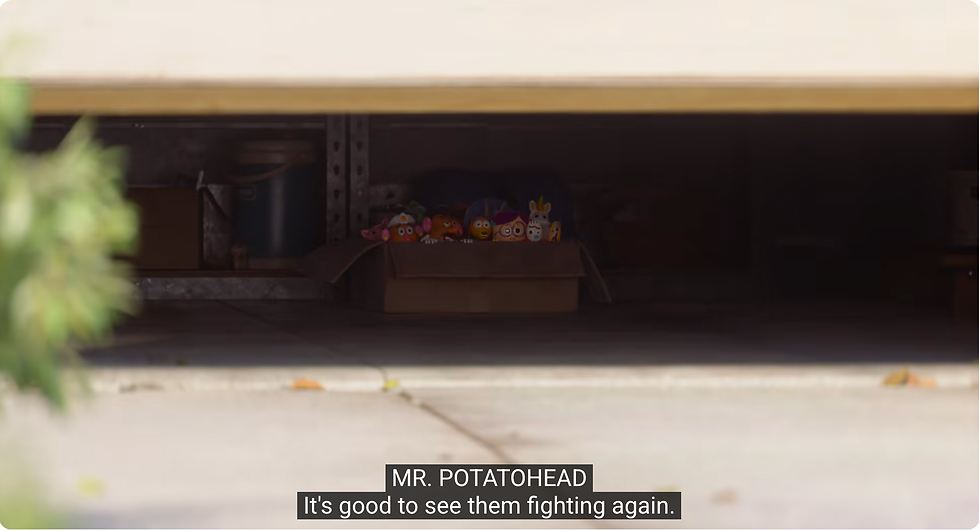
(And I do still believe that Taylor might be playing with POV in the structure of the song and the second verse could connect to Buzz & Woody. Especially since Mr. Potatohead (? Forky?) says, "It's good to see them fighting again" -- maybe echoing Taylor's line, "there were times we could fight like brothers."
Bonnie + Jessie reconnecting is a fitting end for this story, I think -- not the least because it's what I want -- have -- to believe.
Andrew Stanton has said that tech isn't the villain -- and McKenna Harris acknowledges (what we all think) that we're never going to completely give up our phones.
But this is also the studio that gave us Wall-E: the moral of the story was never going to be "abandon toys and surrender to technology completely." They've shown us what happens when we do that. It's not pretty -- and we're already well on our way there.
But advocating for a balance? Reassuring us that both Toys and Tech each have a place and that they can coexist together? That seems like a more hopeful message.
Heck, I doomscroll past my bedtime or read on my Kindle while snuggling with my comfort object, a stuffed dog I've had since literally the day I was born. (These movies really do make it difficult to get rid of toys or stuffed animals; I've found myself apologizing to my kids' stuffed animals when I move them out of their beds and into the over-the-door storage, like I know they'll miss helping their kid.)
Yes, Bonnie can have the Lilypad -- and learn to use it responsibly. But kids should still cultivate their imaginations, play with toys, be outside. It doesn't -- and shouldn't -- have to be one or the other.


Comments